ONE:On the 10th of June, 1768, a sloop called the Liberty, the property of Mr. John Hancock, of Boston, arrived in the harbour of that city laden with a cargo of Madeira wine. Resistance having been offered to the collection of the duties, the comptroller signalled the Romney man-of-war, lying at anchor off Boston, to take the sloop in tow and carry her under her guns. Crowds, meanwhile, had gathered on the quay, and commenced measures for resistance. The captain of the Romney sent out his boat's crew to haul in the sloop, and the mob attacked them with stones. The man-of-war's men, notwithstanding, executed their task, and carried the Liberty under the guns of the Romney.
ONE:The nobles rose in a body and quitted the Assembly; but Gustavus continued his speech to the three remaining Orders. He declared it necessary, for the salvation of the country, for him to assume almost despotic powers, and he called on the three Estates to support him in punishing the traitorous nobles, promising to secure the liberties of the country as soon as this was accomplished. Not only the three Orders, but the public at large zealously supported him. Stockholm was in a state of high excitement. Gustavus surrounded the houses of the chief nobility with his brave Dalecarlians; secured twenty-five of the principal nobles, including the Counts Brah¨¦, Fersen, Horne, and others, who were consigned to the castle. He had already arrested nine of the leaders of the insurrection in the army in Finland, and these officers were[353] now also confined in the castle; others had escaped and fled to their patroness in St. Petersburg. To intimidate the king, nearly all the officers of the army, the fleet, and the civil department threw up their commissions and appointments, believing that they should thus completely paralyse his proceedings. But Gustavus remained undaunted. He filled up the vacancies, as well as he could, from the other Orders of the State; he brought the nobles and officers to trial, and numbers of them were condemned to capital punishment, for treason and abandonment of their sworn duties. Some few examples were made; the rest, after a short confinement, were liberated, and they hastened to their estates in the country. But it was found there, as everywhere else, that rank confers no monopoly of talent. The three other Orders warmly supported Gustavus, and he remodelled the Diet, excluding from it almost all the most powerful nobles, and giving greater preponderance to the other three Orders. In return for this, these Orders sanctioned an act called the Act of Safety, which conferred on the king the same power which is attached to the British Crown, namely, that of making peace or war. They granted him liberal supplies, and he quickly raised an army of fifty thousand men. As he considered the reduction of the restless and lawless power of Russia was equally essential to Britain, Holland, and Prussia, as to Sweden, Gustavus called on them to second his efforts. But Pitt would do nothing more than guarantee the neutrality of Denmark; and even this guarantee he permitted to become nugatory, by allowing the Danish fleet to give protection to the Russian fleet in the Baltic. A second Russian squadron, commanded by Dessein, a French admiral, descended from Archangel, entered the Baltic, menaced Gothenburg, and by the aid of the Danish ships was enabled to join the other Russian fleet at Cronstadt.Long quotations are then given from the several reports of the Assistant Commissioners, showing that the feelings of the suffering labourers in Ireland are also decidedly in favour of emigration. They do not desire workhouses, it is said, but they do desire a free passage to a colony where they may have the means of living by their own industry. The Commissioners then declare that, upon the best consideration they have been able to give to the whole subject, they think that a legal provision should be made and rates levied for the relief and support of curable as well as incurable lunatics, of idiots, epileptic persons, cripples, deaf and dumb, and blind poor, and all who labour under permanent bodily infirmities; such relief and support to be afforded within the walls of public institutions; also for the relief of the sick poor in hospitals and infirmaries, and convalescent establishments; or by external attendance, and a supply of food as well as medicine, where the persons to be relieved are not in a state to be removed from home; also for the purpose of emigration, for the support of penitentiaries¡ªto which vagrants may be sent¡ªand for the maintenance of deserted children; also towards the relief of aged and infirm persons, of orphans, of helpless widows, and young children, of the families of sick persons, and of casual destitution. This report was not signed by all the Commissioners. Three of them set forth their reasons, in thirteen propositions, for dissenting from the principle of the voluntary system, as recommended by the report.
TWO:
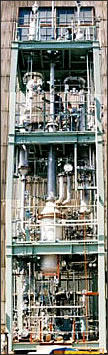
High quality is being demanded in many fields nowadays and so in order to satisfy that we developed a high-purity distillation system in collaboration with Ube industries, Ltd. and Kanto Chemical Co., Inc. The system is used to refine cleaning solutions for the semiconductor industry, medical materials, etc. of high purity (residual ion concentration: 0.01 to 1.0 ppb).
THREE:In the following June Lord Stanhope again came forward with a Bill to remove some of these enactments, and he showed that the literal fulfilment of several of them was now impossible; that as to compelling every man to go to church, by returns lately made to that House it was shown that there were four millions more people in England than all the churches of the Establishment could contain. With respect to the Church enforcing uniformity, he said that the variations between the Book of Common Prayer printed at Oxford and that printed at Cambridge amounted to above four thousand. His Bill was again thrown out by thirty-one against ten; but his end was gained. He had brought the injustice towards the Dissenters so frequently forward, and it was now so glaring, and the Dissenters themselves were become so numerous and influential, that the question could be no longer blinked. On the majority being pronounced against the Bill, Lord Holland rose and asked whether, then, there was to be nothing done to remove the disabilities under which Dissenters laboured? If that were the case, he should be under the necessity of bringing forward a measure on that subject himself. This compelled Ministers to promise that something should be done; and, on the 10th of the same month, Lord Castlereagh proposed to bring in a Bill to repeal certain Acts, and to amend others respecting persons teaching or preaching in certain religious assemblies. This Act, when explained, went to repeal the 13 and 14 Charles II., which imposed penalties on Quakers and others who should refuse to take oaths; the 16 of Charles II., known as the Five Mile Act, which prohibited any preacher who refused to take the non-resistance oath coming within five miles of any corporation where he had preached since the Act of Oblivion, under a penalty of fifty pounds; and the 17, which also imposed fine and imprisonment on them for attempting to teach a school unless they went to church and subscribed a declaration of conformity. It also repealed the 22 Charles II., commonly called the Conventicle Act. Instead of those old restraints, his Act simply required the registration of all places of worship in the bishop's or archdeacon's court; that they must not be locked, bolted, or barred during divine service, and that the preachers must be licensed according to the 19 George III. These conditions being complied with, all persons officiating in, or resorting to such places of worship, became entitled to all the benefits of the Toleration Act, and the disturbance of their assemblies became a punishable offence. This Bill passed both Houses, and became known as the Statute of 52 George III. It was a great step in the progress of religious freedom; and Mr. William Smith, the leader of the Dissenting interests in the House of Commons, expressed his heartfelt gratification at this proof of the increasing liberality of the times.
Our High-purity distillation system provide our clients with high solvent recovery rate, almost 100%.
The quality of the products/output from our system is very stable, which makes production management very easy, and easier than the conventional ion exchange resin method.
No emission of waste brings our clients reduction of running cost for environmental measures.
Our various devices minimize entrainment.
To prevent the elution of metal, you could ask us the system made of Teflon.
Our High-purity distillation system has been already proved for solvents that trigger very rapid decomposition reactions, such as hydrogen peroxide.